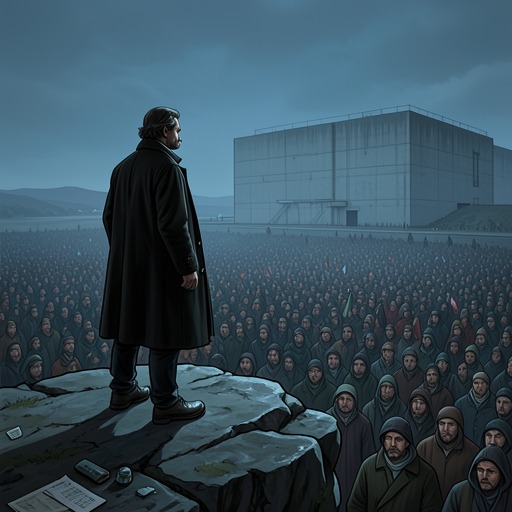
The spirit of a new nobility
Thus Spoke ZarathustraThe spirit of a new nobility is Zarathustra’s proposed answer to a world in which inherited standards of good and evil have lost their authority but new values remain to be made. It is not a title secured by birth, money, or service to rulers. It is a demanding, plural form of value-creation: people must impose commands on themselves, resist ready-made moral certainty, and direct their strength toward a future they will not own alone.
Values, Power, and Self-Mastery
The proposal begins from the claim that evaluation is unavoidable. Zarathustra has encountered many lands and peoples and found that each has its own good and evil; no people can live without evaluating. Yet a people cannot maintain itself by simply taking its neighbour’s standards as its own. Values are not detached truths waiting to be found: they express and preserve a particular form of life. The spirit of a new nobility therefore starts by asking who creates a value, what kind of life it serves, and what power it enables.
In the book’s interpretive account, this connection between evaluation and life leads to the Will to power. The account describes fear as the feeling of an absence of power and presents the drive for power as the underlying motive of human action. A morality, in this analysis, is a people’s table of self-imposed commands: it redirects primitive aggression inward, turning a herd into a people capable of discipline. The same transformation can occur within an individual. When a person imposes commands on himself and obeys them, he changes from an unruly multitude into an ordered whole. The Superman names the achievement of such self-mastery, not mere command over others. The new nobility extends this demanding work from the individual to the making of a future.
Against the Mob and the Self-Satisfied Just
The need for a new nobility is stated as a political and moral opposition: it must stand against both mob-rule and despotism. The danger of the mob lies not only in its ability to become master, but in the shallowness of its sense of time. It looks back only as far as the grandfather, treating the inherited past as the limit of what can be imagined. If that short memory governs, the past is handed on without transformation and time is drowned in shallow waters. Nobility, by contrast, must be capable of looking beyond inheritance and giving the future a form.
Zarathustra also resists the claim of the good and just that they already possess the answer. Their certainty makes the search itself appear blameworthy: they claim to know what justice is and condemn those still seeking it. The book’s sharp reversal is that the harm done by the good may exceed the harm done by the wicked. The point is not that every inherited judgment is simply false, but that a morality becomes dangerous when it presents its own contingent evaluations as complete and forbids their re-examination. The creator, rather than the self-satisfied custodian of settled rules, is the figure who may discover what is good and evil for humanity.
A Plural Nobility, Not a Purchasable Rank
The new nobility is explicitly plural. It requires noble people of many kinds; the ideal is not a single supreme authority or a uniform class reproducing one approved model. Zarathustra’s comparison is to divinity understood as many gods rather than one God. The analogy makes plurality essential: nobility exists through a range of distinct powers and evaluations, not through submission to one final standard.
This distinction also separates the ideal from social rank that can be bought. The nobility Zarathustra directs his listeners toward cannot be acquired like merchandise with money. Price, in this account, is a poor measure of value. Nor is honour to be derived from having served a prince or acted as a bulwark for an existing order. Such service may reinforce what already stands, but the new nobility is measured by what a person is willing to make and become. Its authority comes from the work of creating and cultivating, not from inherited privilege or proximity to power.
The Future as Its Measure
Zarathustra calls the aspiring noble people begetters, cultivators, and sowers of the future. These are complementary tasks: bringing possibilities into being, tending their growth, and planting what may not mature within the cultivators’ own lifetimes. Honour consequently shifts from origin to direction. Where a person is going, rather than where that person came from, is to become the measure of distinction; the will and the step that reach beyond the self become the new signs of honour.
This orientation requires distance from inherited attachments. Zarathustra calls the new nobles fugitives from fatherlands and fore-fatherlands, and directs their love toward The children’s land, an undiscovered country imagined in the furthest sea. The language does not present the future as a secure possession. It must be sought, and those who seek it must set their sails toward what is not yet known. Their task is also reparative: they are to make amends to their children for having been the children of their fathers. The new law they establish redeems the past by refusing merely to repeat it and by making inheritance answerable to what can still be created.
Teaching Without Dependence
The proposal’s form of transmission guards against turning Zarathustra himself into a new authority whose pupils merely repeat his judgments. He tells his disciples to go away and be alone, to guard themselves against him, and even to be ashamed of him in case he has deceived them. A person repays a teacher badly by remaining only a pupil; the pupil should be able to reach for the teacher’s laurels rather than live under their permanent protection. Zarathustra’s further insistence that a person of knowledge must be able both to love enemies and to hate friends makes independence demanding rather than comfortable. Loyalty cannot excuse the surrender of judgment.
In this sense, the new nobility is not a settled constitution or a promise of restored old rank. It is a continuing practice of self-command and value-creation, open to many kinds of future-makers and hostile to claims that moral authority is already complete. Its central test is whether strength can be disciplined into creation: whether people can cease merely to inherit a world, make their values answer to a future beyond themselves, and cultivate forms of life worthy of being handed on.